When distance runners transition from level ground to an incline, the mechanical, metabolic, and neurostructural rules of locomotion undergo a rebuild of sorts. In steady-state level running, the musculoskeletal system operates mainly as a biological spring-mass mechanism. Gravitational potential energy and kinetic energy oscillate approximately 180 out of phase, allowing the lower limb to exploit the elastic compliance of passive connective tissues, in particular the Achilles tendon, plantar fascia, and patellar tendon, to store and recoil energy across the stance phase (Bohm et al., 2021). This allows the calf and quadriceps muscles to remain relatively still, acting as solid anchors while their spring-like tendons do the dynamic work. Because the tendons stretch and recoil independently of the muscle fibres, the muscles themselves avoid exhausting cycles of stretching and shortening. Holding a steady contraction requires far less cellular energy than actively pumping, which dramatically cuts the metabolic cost of generating force with each stride (Bohm et al., 2019)
As gradients increase, this conservative energy-recycling system collapses. Because ascending a slope requires the body to perform continuous net positive mechanical work against gravity to raise the runner’s center of mass with every stride cycle, relying on passive elastic recoil is no longer biomechanically viable. A shift in biomechanics and energy systems is needed.
Biomechanical & Metabolic Shift
To study human movement, researchers often combine inverse dynamics, which calculates the hidden physical forces acting inside joints, with electromyographic evaluations, which measure the electrical signals of the muscles driving that motion. Together, these complementary methods reveal both the mechanical stress placed on the body and how the nervous system recruits muscles to handle that load. Research applying these techniques shows that running on positive inclines redistributes joint kinetics and muscle–tendon interactions far more than equivalent accelerations on flat surfaces.
DeVita et al. (2008) demonstrated that total lower-extremity positive joint work increases by approximately 265% during incline running compared to decline conditions, forcing the neuromusculoskeletal system to change from an energy-dissipating and energy-recycling mode to an energy-generating mode. On flat ground, the ankle and its spring-like tendons do most of the hard mechanical work, bouncing you forward with free, recycled energy. Running uphill changes the equation: that spring mechanism can't lift your body weight, so the main engine for power shifts upward to the hips and knees, which have to drive you up the slope (Pamboris et al., 2025; Roberts & Belliveau, 2005)
As the slope gets steeper, the glutes, upper hamstrings, and quadriceps are forced to fire with powerful concentric contractions to physically hoist your body up and over the planted leg (DeVita et al., 2008; Vernillo et al., 2016). The calves and ankles still deliver a strong push off the ground, but their share of the total workload shrinks as the hips take over the heavy lifting (Pamboris et al., 2025; Roberts & Belliveau, 2005).
Tendons can only return energy that is put into them; they can’t generate fresh power from scratch. Because of this limitation, the muscle fibres can’t remain in an energy-saving holding pattern. Ultrasound imaging shows that running uphill forces muscle fibres to contract and shorten rapidly while the foot is planted (Bohm et al., 2019, 2021). This rapid shortening pushes the muscles directly into a mechanical bind, entirely governed by the force-velocity relationship.
Under this human systems trade-off, the faster a muscle fibre contracts, the less peak force its individual microscopic cross-bridges can exert. To make up for that drop in force and still generate enough vertical push against gravity, your nervous system has to rapidly recruit a much larger pool of muscle fibres. This surge in muscle recruitment burns through cellular fuel (ATP) at an accelerated rate, causing both oxygen demand and the metabolic cost of running to climb steeply as the slope rises (Minetti et al., 2002; Vernillo et al., 2016).
This shift also reshapes your stride mechanics on the surface. Instead of bounding along freely through the air, you spend less time airborne, keep your feet on the ground for a larger % of each stride cycle, and naturally increase your cadence (Padulo et al., 2013; Vernillo et al., 2016). To meet the rising slope, your ankle flexes more deeply with the toes pulled toward the shin, changing the landing angle and shifting initial ground impact forward toward the midfoot or forefoot (Vernillo et al., 2016).
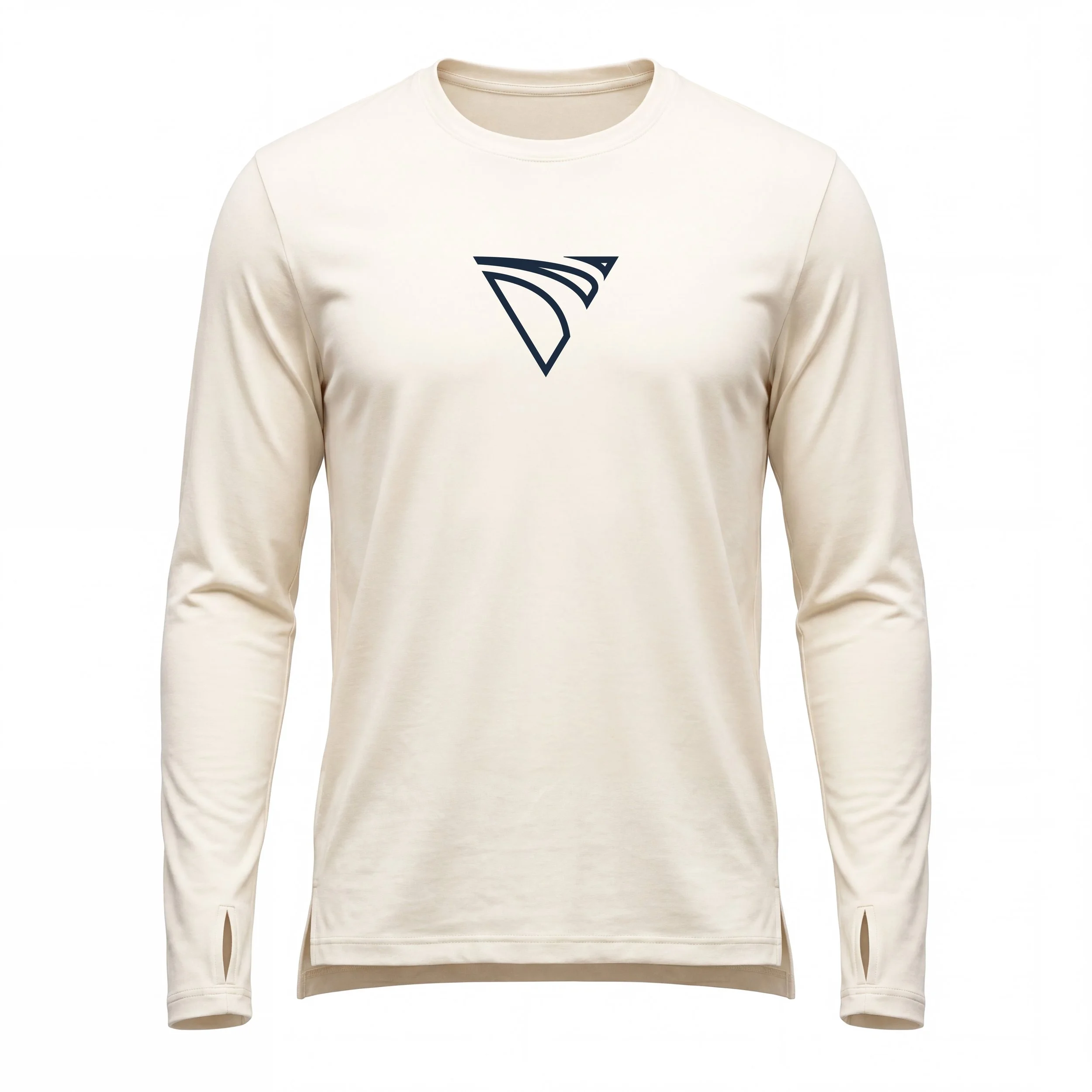
A luxury high performance top intended for track training, warm-ups and training without packs or chest straps.
Stop running in plastic and recycled plastic & run in a predominantly natural fabric with peerless wickability, breathability, comfort and fit.
Expertly fashioned from PARI™ , our next‑generation running fabric engineered from a high‑density 95% Lyocell™ base with 5% spandex for controlled stretch. It delivers a uniquely calm, cool, and stable running experience across a wide temperature range.
Thermoregulation
Tencel (cellulose fibre) has one of the highest moisture‑regain capacities of any performance fibre, giving PARI™:
rapid moisture uptake without surface wetness
a cool‑touch feel during exertion
stable thermal behaviour in warm–moderate conditions
reduced cling and reduced “swamp‑shirt” effect
Ideal for 10–25°C running conditions.
Moisture Management
Unlike polyester (which repels moisture), Tencel absorbs sweat into the fibre core, spreads it, and releases it steadily; delivering:
smoother evaporative cooling
less salt‑crusting
reduced odour build‑up
more consistent comfort over long runs
Softness + Skin Comfort
Tencel fibres have a smooth, rounded cross‑section, giving PARI™:
exceptional softness
reduced micro‑abrasion
low friction under pack straps or repetitive arm swing
suitability for sensitive skin
Movement Stability — controlled stretch, no sag
The 5% spandex is calibrated to maintain:
shape retention
garment stability during sweat load
freedom of movement without bounce
a clean silhouette that doesn’t bag out over time
Breathability — high airflow with a calm thermal profile
Tencel’s internal structure allows:
high vapour transmission
excellent airflow
Estimated UPF Protection Level
UPF 20–25
PARI™ (95% Tencel / 5% Spandex)
A high‑performance running fabric engineered for natural thermoregulation, exceptional softness, and stable movement. Tencel’s dense, smooth fibres deliver cool‑touch comfort, fast moisture uptake, and reduced odour, while 5% spandex maintains shape and freedom of movement. The mid‑weight knit provides natural UV protection (UPF 25 ). Designed for runners who want natural‑fibre intelligence with modern performance.
Read the swing tag provided with its detailed care instructions. Cold hand wash only.
The Masters Aged Runner
For masters aged athletes the uphill challenge is greater by far. In younger runners, the nervous system taps into deep reserves of high-velocity, high-force Type II fibres. With age, sarcopenia and dynapenia selectively denervate and atrophy Type II motor units. Because masters runners have fewer viable fast-twitch fibres to recruit, their remaining muscle fibres must operate much closer to their absolute ceiling of recruitment. This leaves older runners with virtually zero mechanical buffer on steep inclines, resulting in rapid premature fatigue.
To generate enough upward propulsion during the brief ground contact phase of an uphill stride, force must be produced almost instantaneously. Aging degrades central motor drive, lowers maximal motor unit firing frequencies, and slows calcium kinetics in the sarcoplasmic reticulum. As a result, the older runner struggles to achieve the rapid rate of force development required when the muscle cannot rely on pre-stretched elastic tension.
While younger tendons act as stiff, efficient springs that store and release strain energy with minimal hysteresis (this is the loss of energy as heat when a tendon is stretched <loaded> and then allowed to recoil <unloaded>; lower hysteresis means a tendon returns a higher percentage of the stored elastic energy to help power movements like walking, running, or hopping) , aging tendons undergo structural remodeling. Tendons often experience a decrease in material stiffness and collagen turnover, becoming more compliant or mechanically disorganized.
When a tendon is too compliant, the attached muscle fascicles must shorten even further and faster to take up tendon slack before transferring force to the bone. This pushes the muscle fibres further down the force-velocity curve into a zone of very low force generation and at a higher metabolic cost.
We will examine approaches that will help older runners overcome to a large degree their compromised systems to remain effective hill runners.
Back to the uphill posture. It keeps the ankle and knee under heavy leverage for longer, forcing the lower body to grind through sustained tension rather than springing off the ground. Instead of a quick, elastic bounce, the glutes, quadriceps, and deep calf (the soleus) must produce continuous, non-rebounding force to push the body up the slope.
Trying to keep a fast pace running uphill requires a comprehensive training approach: one designed to build pure concentric pushing power, increase usable joint mobility, wake up powerful high-threshold muscle fibers, and speed up recovery between demanding sessions.
Targeted Protocols
Ascending steep grades demands both extreme joint angles under load and instant motor unit recruitment from the initial ground strike. A traditional steady jog isn’t enough to prepare the contractile machinery for the high torque and dorsiflexion demands of hill climbing.
Mobility Protocols
Stiff joints in the lower body waste mechanical energy, force your lower back to arch excessively to compensate, and burn out your calves well before their time:
Ankle Mobility (Dorsiflexion)
Steep slopes force your shin to track far forward over your foot while supporting several times your body weight. If your ankle can’t flex deeply, your body compensates by collapsing the arch of your foot inward or over-flexing the knee, shifting stress where it doesn’t belong and you don't need it. To address this, perform banded knee-to-wall mobilisations: loop a thick resistance band low across the front ankle crease to help the joint glide freely, pulsing smoothly through 2 sets of 10–12 reps per leg.
Hip Flexor Length and Extension
While uphill running requires pulling the knee up high on landing, you still need to extend your trailing leg completely behind you at push-off. If your hip flexors (the psoas and upper quad) are glued tight, your pelvis tilts forward and dumps shear stress directly into your lumbar spine. You can learn to counter this with dynamic half-kneeling pelvic tucks: drop into a lunge on one knee, tuck your tailbone, squeeze that trailing glute to open the front of the hip, and reach overhead with the same arm to mobilize the hip while keeping the pelvis stable.
Upper Back (Thoracic <T>Spine) Freedom
Ascending an incline means a forward lean from the ankles to match the slope. If your upper back is stiff and rounded, it compresses your rib cage, restricting full, deep diaphragmatic breathing and locks up the rotational arm swing you need to counterbalance powerful hip drive. Quadruped upper-back rotations (on hands and knees) and extensions over a foam roller open up the chest and restore the rotational freedom needed to breathe and counter-balance efficiently.
Activation and Potentiation
Easy flat jogging leaves your most powerful fast-twitch muscle fibres completely asleep. To wake these up and prime the nervous system to produce forceful contractions before you hit an incline, warm-ups must combine dynamic movement with targeted priming drills (Esteban-García et al., 2024):
Dynamic Movement Flow (6–8 minutes)
Move through walking lunges with an overhead reach, high-knee marches (pulling the toes actively toward the shins), lateral lunges, and inchworms with calf pedals. This raises muscle temperature, lubricates the joints, and moves the body through the full ranges of motion required on a hill (Esteban-García et al., 2024).
Targeted Hip Priming
Mini-Band Lateral & Monster Walks
2 sets of 15 steps per direction with an elastic loop just below the knees. This fires up the side glutes (gluteus medius) to keep your pelvis level and prevent your knees from collapsing inward on steep climbs.
Single-Leg Isometric Hip Thrusts
2 sets of 5-second maximal holds locked out at the top of a single-leg bridge. Squeezing as hard as possible at the top ramps up the neural signal from the brain straight to the gluteus maximus.
Ankle Stiffness and Stride Priming
Pogo Hops & Ankle Bounds
2 sets of 20 quick, springy vertical bounces. Focus on landing with stiff ankles and minimal knee bend to pre-tension the calf and Achilles tendon so they can handle rapid ground contact.
Short Incline Strides
3 to 4 reps of 10-second hill accelerations on a moderate slope (6–8% grade). Build progressively from an easy aerobic pace up to roughly 95% effort, walking all the way back down to fully recover between each rep.
Strength and Conditioning
Distance running alone does not generate sufficient peak muscular tension to maximize motor unit synchronization, rate of force development (RFD), or tendon stiffness. Systematic strength training significantly enhances running economy, neuromuscular efficiency, and maximal power output in endurance athletes without inducing detrimental hypertrophy (Beattie et al., 2017; Blagrove et al., 2017).
High-Load Strength and Hypertrophic-Resistant Protocols
Heavy resistance training (HRT) using high loads (80% 1RM) and low repetition volumes (3–6 repetitions) targets neural adaptations—such as elevated motor unit recruitment thresholds and rate coding—rather than substantial sarcoplasmic hypertrophy, which could compromise power-to-weight ratio (Beattie et al., 2017; Blagrove et al., 2017).
Barbell Hip Thrust
By providing peak resistance in terminal hip extension where the gluteus maximus is in its shortest, strongest position, hip thrusts overload the primary engine of graded propulsion.
Prescription
3–4 sets of 4–6 repetitions at 80–85% 1RM, emphasizing explosive concentric extension and a 2-second peak hold.
Rear-Foot Elevated Split Squats (Bulgarian Split Squats)
This exercise replicates the single-leg stance demands of uphill running, placing high unilateral concentric demands on the knee extensors (vastus group) and gluteal complex while training lateral hip stability.
Prescription
3–4 sets of 5 repetitions per leg, lowering under control for 3 seconds followed by explosive concentric drive.
Heavy Step-Ups onto an Elevated Box
Using a box height set between 30 and 45 cm, athletes step up without pushing off the rear foot, forcing the lead limb's gluteus maximus and quadriceps to perform pure concentric work against gravity.
Prescription
3 sets of 6 repetitions per limb with dumbbells or a barbell.
Targeted Triceps Surae and Achilles Adaptations
To improve force transmission and structural stiffness in the lower leg, training must address both the soleus and gastrocnemius muscles. Tendon stiffness and muscle strength adapt selectively to high-strain, high-magnitude cyclic loads (Albracht & Arampatzis, 2013; Bohm et al., 2015).
Seated Calf Raises (Soleus Isolation)
With the knee bent at 90, the biarticular gastrocnemius is functionally slackened, placing nearly all mechanical tension across the soleus.
Prescription
4 sets of 6–8 repetitions at 80% 1RM with a 3-second eccentric phase and a 1-second pause at the bottom.
Standing Barbell Calf Raises (Gastrocnemius and Achilles Complex)
Performed with straight knees over an elevated platform to induce full stretch and high tensile load on the Achilles tendon (Albracht & Arampatzis, 2013; Bohm et al., 2015).
Prescription
4 sets of 5 repetitions with heavy loads.
Incline Locomotor Conditioning
Field-based running conditioning should integrate progressive incline intervals to develop metabolic buffering capacity and mechanical power in the targeted movement pattern.
Short, Alactic Hill Sprints
6–10 repetitions of 8–10 seconds at maximal sprint velocity on a steep slope (10–15% incline), with 2 to 3 minutes of walking recovery. This protocol maximally taxes high-threshold motor unit recruitment and concentric rate of force development without accumulating substantial metabolic byproducts.
Sustained Threshold Incline Climbs
4–6 repetitions of 3–5 minutes at lactate threshold intensity on a moderate slope (6–8% incline), with a slow jog-down recovery. This format trains concentric metabolic durability, local muscle capillarization, and cardiovascular stroke volume under high duty-factor demands (Minetti et al., 2002; Padulo et al., 2013).
Recovery & MusculAR Durability
The physiological fatigue generated by uphill running differs substantially from downhill or flat running. Downhill running induces extensive micro-tearing and delayed onset muscle soreness (DOMS) via high eccentric impact forces (Vernillo et al., 2016). Conversely, uphill running induces primarily metabolic and neuromuscular fatigue, characterized by high rates of glycogen breakdown, rapid ATP hydrolysis, and peripheral fatigue in the hip and knee extensors.
A comprehensive review of post-exercise recovery modalities demonstrates that passive rest alone can be enhanced by targeted physical interventions (Barnett, 2006). A meta-analysis by Dupuy et al. (2018) established that techniques such as sports massage, compression garments, and active recovery offer the largest effect sizes for reducing DOMS, systemic inflammation, and the sensation of fatigue.
Active Recovery and Hydrotherapy
Following strenuous uphill running workouts, 15–20 minutes of non-weight-bearing active recovery (e.g., low-resistance cycling or pool running at <55%- VO2max) accelerates localized lactate clearance, increases blood flow, and lowers subjective muscle soreness without adding mechanical impact (Barnett, 2006).
Cold water immersion (10–15 minutes at 11–15°C) can acutely reduce core temperature and blunt subjective perceptions of muscular fatigue following strenuous hill sessions (Dupuy et al., 2018). However, it should be used judiciously in strength-focused blocks to avoid blunting anabolic signaling pathways.
Compression and Myofascial Therapies
Applying graduated compression tights (15–25 mmHg) post-session promotes venous return and reduces post-workout muscle soreness and perceived fatigue (Dupuy et al., 2018).
Targeted myofascial release (foam rolling and percussion therapy) applied to the soleus, gastrocnemius, quadriceps, and gluteal complexes for 90–120 seconds per muscle group helps restore resting soft-tissue compliance without acutely reducing contractile force output.
Nutritional and Collagen Kinetics
Uphill running drains intramuscular glycogen stores rapidly due to continuous concentric mechanical work (Minetti et al., 2002). Consuming 1.0–1.2 grams of high-glycemic carbohydrates per kilogram of body mass per hour within the first four hours post-workout accelerates glycogen replenishment.
To maintain tendon tissue integrity and encourage collagen cross-linking after high-strain sessions (Bohm et al., 2015), athletes can ingest 15 grams of hydrolyzed collagen with 50 milligrams of vitamin C roughly 45–60 minutes prior to targeted resistance or hill-sprint sessions.
Generic Training for Hill Running
The following periodised matrix provides an applied weekly structure to integrate strength, activation, mobility, and recovery routines alongside specific running training.
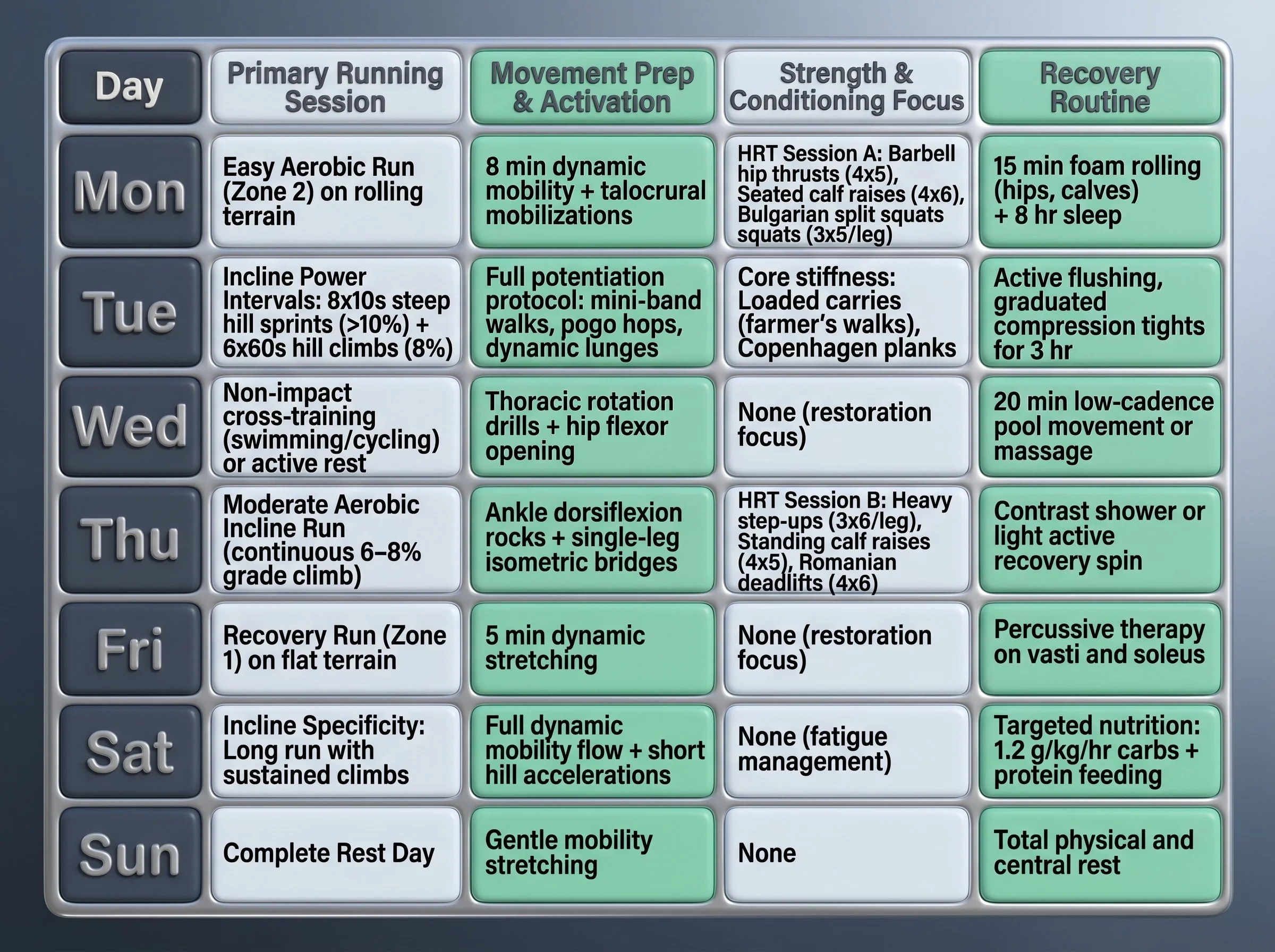
Moving away from the passive elastic mechanics of flat running requires remodeling how the body generates force. On an incline, running speed and economy depend on the neuromuscular system's ability to produce sustained concentric torque against gravity. By combining high-load compound lifting to raise motor unit recruitment ceilings, progressive tendon conditioning to withstand strain, and targeted mobility and recovery protocols to maintain soft-tissue compliance, athletes and coaches can systematically prepare for the distinct mechanical demands of graded locomotion.
Bibliography
Albracht, K., & Arampatzis, A. (2013). Exercise-induced changes in triceps surae tendon stiffness and muscle strength affect running economy in humans. European Journal of Applied Physiology, 113, 1605–1615. https://doi.org/10.1007/s00421-012-2585-4
Cited by: 269
Barnett, A. (2006). Using recovery modalities between training sessions in elite athletes. Sports Medicine, 36, 781–796. https://doi.org/10.2165/00007256-200636090-00005
Cited by: 1230
Beattie, K., Carson, B. P., Lyons, M., Rossiter, A., & Kenny, I. C. (2017). The effect of strength training on performance indicators in distance runners. Journal of Strength and Conditioning Research, 31, 9–23. https://doi.org/10.1519/jsc.0000000000001464
Cited by: 190
Blagrove, R. C., Howatson, G., & Hayes, P. R. (2017). Effects of strength training on the physiological determinants of middle- and long-distance running performance: A systematic review. Sports Medicine, 48, 1117–1149. https://doi.org/10.1007/s40279-017-0835-7
Cited by: 403
Bohm, S., Mersmann, F., & Arampatzis, A. (2015). Human tendon adaptation in response to mechanical loading: a systematic review and meta-analysis of exercise intervention studies on healthy adults. Sports Medicine - Open, 1, 7. https://doi.org/10.1186/s40798-015-0009-9
Cited by: 739
Bohm, S., Mersmann, F., Santuz, A., & Arampatzis, A. (2019). The force–length–velocity potential of the human soleus muscle is related to the energetic cost of running. Proceedings of the Royal Society B: Biological Sciences, 286, 20192560. https://doi.org/10.1098/rspb.2019.2560
Cited by: 144
Bohm, S., Mersmann, F., Santuz, A., Schroll, A., & Arampatzis, A. (2021). Muscle-specific economy of force generation and efficiency of work production during human running. eLife, 10, e67182. https://doi.org/10.7554/elife.67182
Cited by: 58
DeVita, P., Janshen, L., Rider, P., Solnik, S., & Hortobágyi, T. (2008). Muscle work is biased toward energy generation over dissipation in non-level running. Journal of Biomechanics, 41, 3354–3359. https://doi.org/10.1016/j.jbiomech.2008.09.024
Cited by: 99
Dupuy, O., Douzi, W., Theurot, D., Bosquet, L., & Dugué, B. (2018). An Evidence-Based Approach for Choosing Post-exercise Recovery Techniques to Reduce Markers of Muscle Damage, Soreness, Fatigue, and Inflammation: A Systematic Review With Meta-Analysis. Frontiers in Physiology, 9, 403. https://doi.org/10.3389/fphys.2018.00403
Cited by: 918
Esteban-García, P., Abián-Vicen, J., Sánchez-Infante, J., Ramírez-delaCruz, M., & Rubio-Arias, J. Á. (2024). Does the Inclusion of Static or Dynamic Stretching in the Warm-Up Routine Improve Jump Height and ROM in Physically Active Individuals? A Systematic Review with Meta-Analysis. Applied Sciences, 14, 3872. https://doi.org/10.3390/app14093872
Cited by: 34
Minetti, A. E., Moia, C., Roi, G. S., Susta, D., & Ferretti, G. (2002). Energy cost of walking and running at extreme uphill and downhill slopes. Journal of Applied Physiology, 93, 1039–1046. https://doi.org/10.1152/japplphysiol.01177.2001
Cited by: 906
Padulo, J., Powell, D., Milia, R., & Ardigò, L. P. (2013). A Paradigm of Uphill Running. PLoS ONE, 8, e69006. https://doi.org/10.1371/journal.pone.0069006
Cited by: 153
Pamboris, G. M., Nelson, A. K., Williams, L., et al. (2025). Inclined distance running at iso-efficient speeds: Effect on joint work. Journal of Sports Sciences, 1–6. https://doi.org/10.1080/02640414.2024.2440675
Cited by: 1
Roberts, T. J., & Belliveau, R. A. (2005). Sources of mechanical power for uphill running in humans. Journal of Experimental Biology, 208, 1963–1970. https://doi.org/10.1242/jeb.01555
Cited by: 187
Vernillo, G., Giandolini, M., Edwards, W. B., et al. (2016). Biomechanics and Physiology of Uphill and Downhill Running. Sports Medicine, 47, 615–629. https://doi.org/10.1007/s40279-016-0605-y
Cited by: 398