
CITY immersive
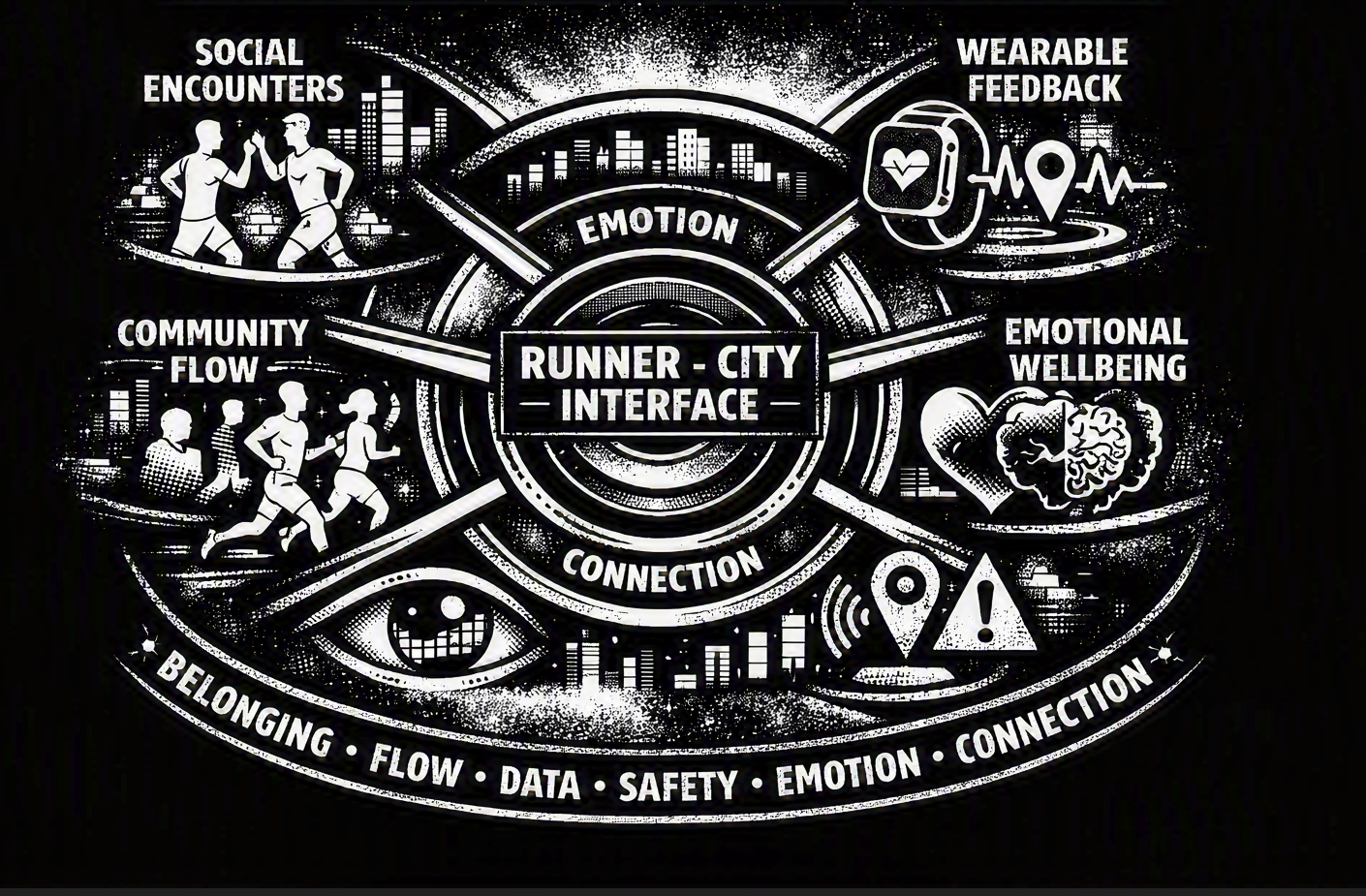
Any city is more than hustle, poor manners, overcrowding, housing stratification and interesting places to eat and be entertained. It is a living, shifting chameleon of sensory & cognitive assaults that the average runner tends to navigate stride after stride. Urban psychogeography becomes a three‑way negotiation between the built environment, the runner’s nervous system, and now the data streams of wearables. The runner is no longer just a body moving through space, but a sensor platform, continuously sampling the city and folding those signals back into perception, decision‑making, and safety.
Psychogeography
This field, as Debord (1955) framed it, was a critique of how urban space shapes emotion and behaviour, often without our consent. A runner embraces that shaping and then subverts it. Hills cease to be cartographic features and become physiological events, marked in memory by heart‑rate spikes, lactate burn, and altered stride mechanics (Vernillo et al., 2017). The mental map that emerges is not a neutral diagram but a layered, lived archive: where freshly laid asphalt softens impact, where jarring concrete punishes joints, where tree canopies cool the skin, and where traffic lights mess up rhythm. Lynch’s (1960) paths, edges, nodes, and landmarks are still there, but they are over‑written by effort, recovery, interruptions and the micro‑textures of, often, varied terrain. The runner’s city is a felt topology, not a drawn one.
Wearables
Wearables intensify this remapping. GPS watches, heart‑rate straps, foot pods, and inertial sensors turn every route into a quantified narrative. Each hill is now tagged with gradient, pace decay, and heart‑rate drift; each intersection is associated with cadence disruption and braking forces. Recent work on wearables, wayfinding, and data visualisations in distance running shows how runners use real‑time feedback and post‑run maps to refine route choice, pacing strategies, and environmental preferences (Toner & Al, 2025). The psychogeographic experience becomes bidirectional: the city shapes the runner’s physiology, and the runner’s data traces begin to shape how they choose to inhabit the city. Heat maps of past runs reveal desired paths not just in grassed corners and odd public green spaces but in digital overlays: bunches of routes where the runner has found optimal combinations of safety, flow, and physiological challenge.
This data‑rich mapping has direct implications for kinematics and safety. Urban running is frictional: constant contact and negotiation with pedestrians, curbs, cambers, and traffic demands high cognitive load and anticipatory regulation (Brymer & Davids, 2013). Wearables can reduce some of that cognitive burden by externalising information that would otherwise be held in working memory. Pace alerts prevent over‑striding in downhill segments; cadence prompts help maintain stable leg turnover on uneven surfaces; heart‑rate zones warn when environmental stressors, heat, noise, and air quality are silently pushing the runner into unsustainable intensity, to a lesser extent, of course. Studies using large‑scale city images and GPS trajectories show that visual environment characteristics- greenery, openness, perceived safety- predict where people choose to jog and how long they stay there (Li et al., 2024). When those environmental cues are coupled with wearable data, runners can, over time and through experience, refine their urban routes to minimise risk hotspots and maximise exercise benefit in a timely way.
Mind mapping
Mind mapping of the urban “runscape “ becomes, in this sense, a safety technology as much as a mental background narrative. Through repeated exposure and data feedback, the runner learns which intersections consistently make you stop suddenly, increasing joint load and fall risk; which narrow footpaths force asymmetrical stride patterns; and which downhill segments might encourage reckless speed and over‑striding. Ecological dynamics research emphasises that skilled movement emerges from continuous coupling between perception and action in specific environments (Brymer & Davids, 2013). Wearables extend perception by adding invisible layers: gradient profiles, historical split times, heart‑rate variability trends, and even near‑miss incident logs if runners annotate their maps. Over time, the cognitive map of the city isn’t just a memory of where you ran, but a network of “safe kinematic corridors” where stride, speed, and situational awareness are balanced.
The psychological dimension deepens as well. Bodin and Hartig (2003) showed that outdoor environments modulate psychological restoration during running, with green and blue spaces generally lowering cortisol and perceived exertion compared to dense urban grids. Yet urban runners often report flow states in the very environments that, on paper, should be more stressful. Recent work on urban marathons suggests that runners reconstruct spatial meaning through visual metaphors and event atmospheres, forming strong place bonds with city routes that are emotionally and symbolically charged (Wang et al., 2026). Wearables add another layer of meaning: the city becomes a repository of personal records, recovery runs, and comeback routes after injury. A particular bridge is not just a boring structure; it is “where my heart‑rate finally stayed below threshold, even after an acceleration.”

A luxury high performance top intended for track training, warm-ups and training without packs or chest straps.
Stop running in plastic and recycled plastic & run in a predominantly natural fabric with peerless wickability, breathability, comfort and fit.
Expertly fashioned from PARI™ , our next‑generation running fabric engineered from a high‑density 95% Lyocell™ base with 5% spandex for controlled stretch. It delivers a uniquely calm, cool, and stable running experience across a wide temperature range.
Thermoregulation
Tencel (cellulose fibre) has one of the highest moisture‑regain capacities of any performance fibre, giving PARI™:
rapid moisture uptake without surface wetness
a cool‑touch feel during exertion
stable thermal behaviour in warm–moderate conditions
reduced cling and reduced “swamp‑shirt” effect
Ideal for 10–25°C running conditions.
Moisture Management
Unlike polyester (which repels moisture), Tencel absorbs sweat into the fibre core, spreads it, and releases it steadily; delivering:
smoother evaporative cooling
less salt‑crusting
reduced odour build‑up
more consistent comfort over long runs
Softness + Skin Comfort
Tencel fibres have a smooth, rounded cross‑section, giving PARI™:
exceptional softness
reduced micro‑abrasion
low friction under pack straps or repetitive arm swing
suitability for sensitive skin
Movement Stability — controlled stretch, no sag
The 5% spandex is calibrated to maintain:
shape retention
garment stability during sweat load
freedom of movement without bounce
a clean silhouette that doesn’t bag out over time
Breathability — high airflow with a calm thermal profile
Tencel’s internal structure allows:
high vapour transmission
excellent airflow
Estimated UPF Protection Level
UPF 20–25
PARI™ (95% Tencel / 5% Spandex)
A high‑performance running fabric engineered for natural thermoregulation, exceptional softness, and stable movement. Tencel’s dense, smooth fibres deliver cool‑touch comfort, fast moisture uptake, and reduced odour, while 5% spandex maintains shape and freedom of movement. The mid‑weight knit provides natural UV protection (UPF 25 ). Designed for runners who want natural‑fibre intelligence with modern performance.
Read the swing tag provided with its detailed care instructions. Cold hand wash only.
The psychogeographic narrative unites architecture, physiology, and data into one whole story. It has as its place in the hierarchy of motivations to persist with running.
Kinematics
From a kinematic standpoint, this fusion can be leveraged deliberately. Sensory‑based route recommendation systems already experiment with mapping noise, light, and surface quality to suggest paths that align with runners’ preferences and performance goals (Anagnostopoulos, 2023; Ouyang et al., 2025). Avid athletes tend to treat the city as a training engine: uphill segments become scheduled strength‑endurance intervals; shaded boulevards become recovery corridors; long, uninterrupted paths become tempo lanes. Wearables provide the feedback loop to validate whether these psychogeographic intentions are actually producing the desired mechanical and physiological outcomes. If a “recovery corridor” consistently shows elevated heart rate and reduced HRV post‑run, the map is wrong and must be redrawn.
The Social Fabric
Urban running is a choreography of chance encounters, the nod exchanged with another runner, the brief eye contact with a cyclist, the rhythm of footsteps echoing down a laneway. These micro‑interactions, though transient, form a lattice of social connectivity that is supportive of emotional wellbeing.
Research in environmental and social psychology has shown that incidental social contact, even brief, nonverbal exchanges, can elevate mood, reduce perceived isolation, and strengthen a sense of belonging (Sandstrom & Dunn, 2014). The urban runner, immersed in the city’s movements, its constant ebb and flow, experiences these encounters as an emotional punctuation mark: a smile at a crossing, a shared pace along the waterfront, a quick pause at a red light. Each moment builds on one another to reinforce the runner’s fit within the urban ecosystem.
Running becomes an important social ritual. The city’s architecture provides the stage, but the actors are its inhabitants; pedestrians, vendors, cyclists, and fellow runners, whose presence transforms the route into a lively village. The runner’s psychogeographic map expands beyond physical terrain to include emotional landmarks: the friendly café owner who waves each morning, the street musician whose rhythm syncs with cadence, the familiar faces that mark progress through the week.
Wearables and the Social Layer
Wearable technology actively brokers this social dimension. Devices like GPS watches and smart rings not only quantify performance but they connect runners to their preferred digital communities. Platforms such as Strava or Garmin Connect create virtual networks where routes, achievements, and encouragement are shared. These systems extend the psychogeographic experience into the digital realm, turning solitary runs into collective narratives.
Studies on digital social support in physical activity show that online interaction through wearables enhances motivation, adherence, and perceived social connectedness (Maher et al., 2021). The runner’s data becomes a social record, a trace of effort that shouts recognition and my elicit empathy. The city, once mapped by physical exertion, is now co‑mapped by data and dialogue.
Emotional Wellbeing
Urban running’s emotional benefits are amplified by this double connection, physical and digital. The rhythmic motion through familiar streets can encourage flow states, while the awareness of shared experience, both in real time and online, reinforces psychological recovery and mental health resilience. Bodin and Hartig (2003) demonstrated that environmental context shapes the restorative quality of running; adding social resonance deepens that effect. The runner’s mind oscillates between solitude and connection, between introspection and communal belonging.
Wearables also serve as emotional regulators. Heart‑rate variability tracking, stress‑monitoring algorithms, and recovery prompts help runners identify when urban friction- noise, crowd density, or heat begins to eat away at wellbeing. By integrating physiological feedback with social data, runners can design routes that balance challenge and comfort, solitude and sociability without exhausting them. Anything that supports persistence is positive for all aspects of health.
Safety
This is where the convergence of psychogeography and wearables may be most powerful. Constant scanning and micro‑adjusting of thoughts and movements is cognitively expensive and, with it, energy-sapping. By offloading some monitoring to devices (for example, vibration alerts for approaching vehicles, fall‑detection algorithms, or geofenced warnings near high‑risk intersections), runners can preserve attentional bandwidth for the reading of surfaces and crowds. At the same time, over‑reliance on devices can dull situational awareness, so the art lies in using wearables as quiet companions rather than loud commanders. The ideal state is one where the runner’s embodied knowledge of the city and the device’s data streams are in dialogue: each confirming, challenging, and refining the other.
Social connectivity contributes to safety as well. Familiar faces and predictable patterns of movement create informal surveillance networks that may help protect runners in complex and confusing urban environments. Wearables enhance this through live‑tracking features and incident alerts, transforming social empathy into practical safety infrastructure. The runner’s wellbeing is thus sustained by both human presence and technological mediation.
References
Anagnostopoulos, A. (2023). Modelling runnable cities for a future city-living strategy. Transportation Research Procedia, 72, 4452–4459.
Bachelard, G. (1958). The poetics of space. Presses Universitaires de France.
Bodin, M., & Hartig, T. (2003). Does the outdoor environment matter for psychological restoration gained through running? Psychology of Sport and Exercise, 4(2), 141–153. https://doi.org/10.1016/S1469-0292(01)00038-3 (doi.org in Bing)
Brymer, E., & Davids, K. (2013). Ecological dynamics as a framework for exploring the relationship between humans and the natural environment. Ecological Psychology, 25(3), 253–272. https://doi.org/10.1080/10407413.2013.811488 (doi.org in Bing)
Debord, G. (1955). Introduction to a critique of urban geography. Les Lèvres Nues, 6.
Li, X., Chen, Y., & Zhao, Q. (2024). How does visual environment affect outdoor jogging behavior? Insights from large-scale city images and GPS trajectories. Urban Forestry & Urban Greening, 95, 128291.
Lynch, K. (1960). The image of the city. MIT Press.
Toner, J., & Al, J. (2025). Wearables, wayfinding, and data visualisations for distance running. Performance Enhancement & Health, 13(1), 100315.
Vernillo, G., Giandolini, M., Edwards, W. B., Morin, J. B., Samozino, P., Horvais, N., & Millet, G. Y. (2017). Biomechanics and physiology of uphill and downhill running. Sports Medicine, 47(4), 615–629. https://doi.org/10.1007/s40279-016-0605-y (doi.org in Bing)
Wang, Y., Song, H., Lu, J., & Wei, J. (2026). Visual metaphors promote place bonding in urban marathon participation through emotional involvement and spatial meaning reconstruction: A ZMET–PLS-SEM study. Frontiers in Psychology, 17, 1921873.